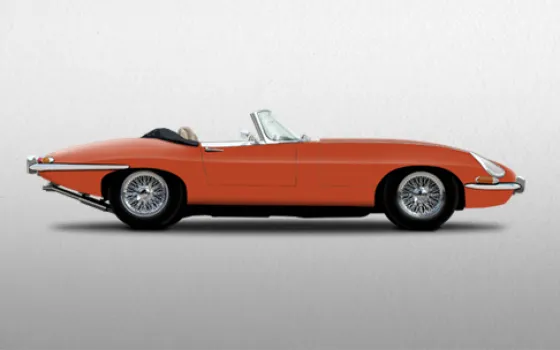
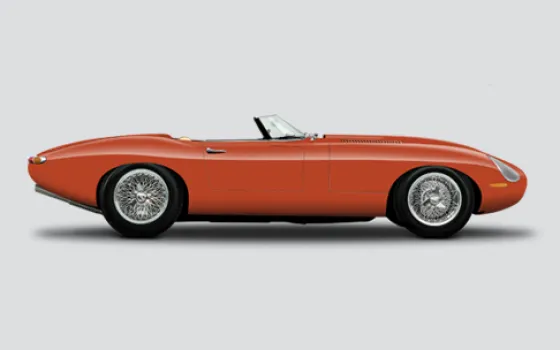
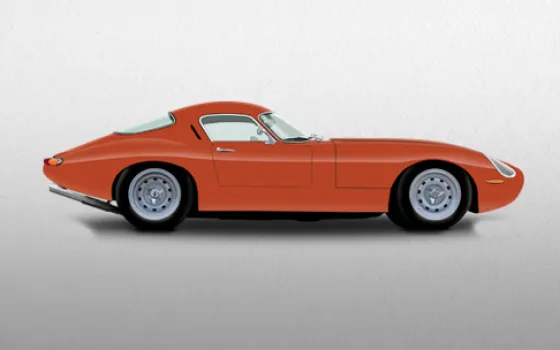
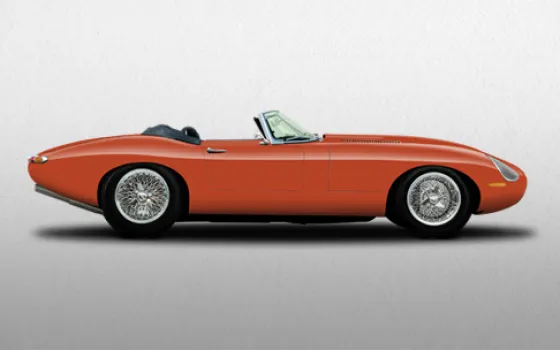
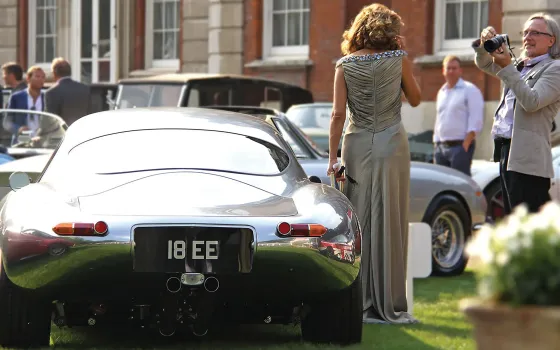

This is a car balanced as naturally as a car can be, the gateway to its discovery a front end of astonishing bite.
John Simister drives an Eagle Heritage E-Type and finds an 'E-type with its character intact but exorcised of the worry factor.'
Thoroughbred and Classic Cars / 11th February 2002
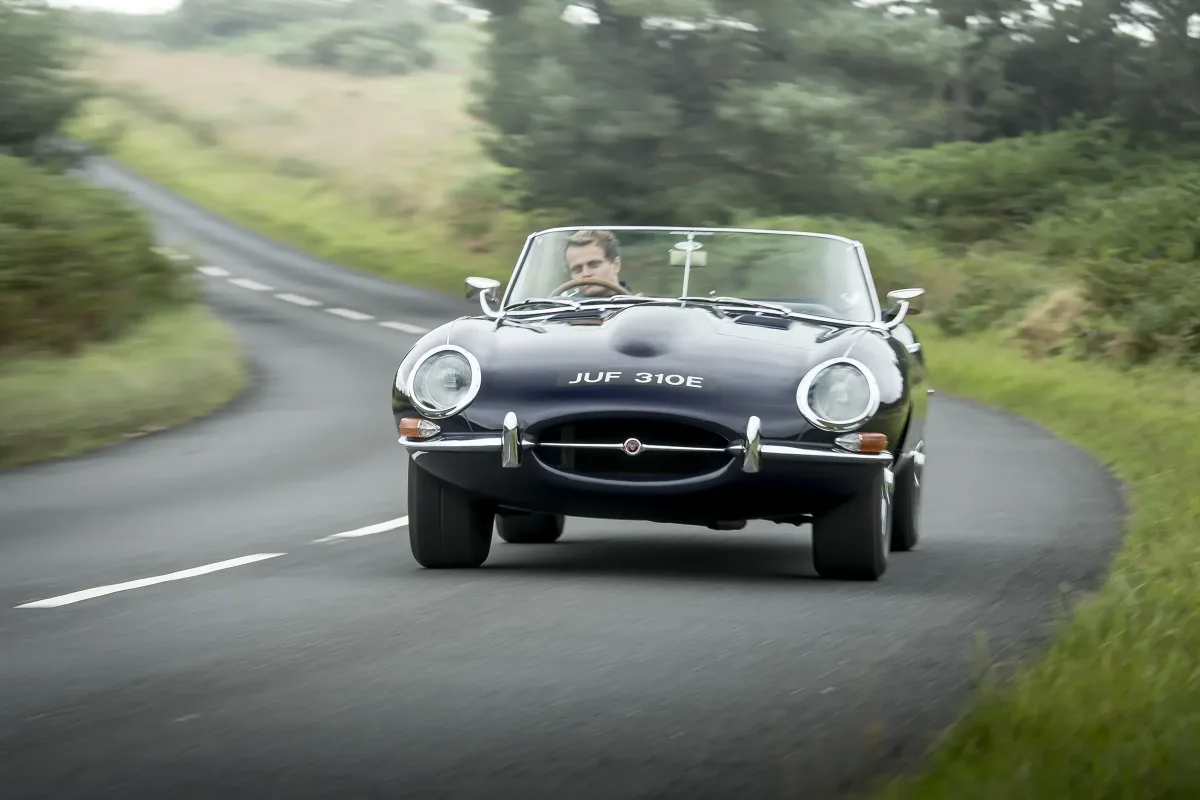
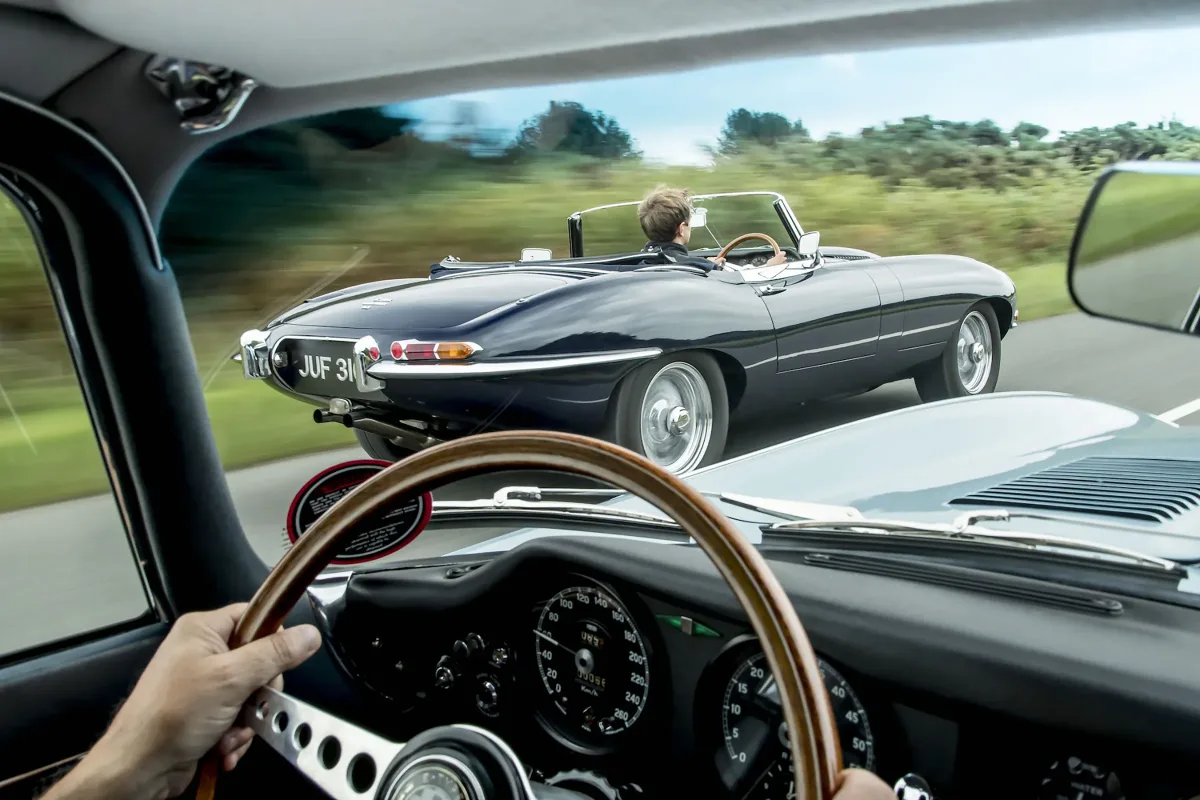
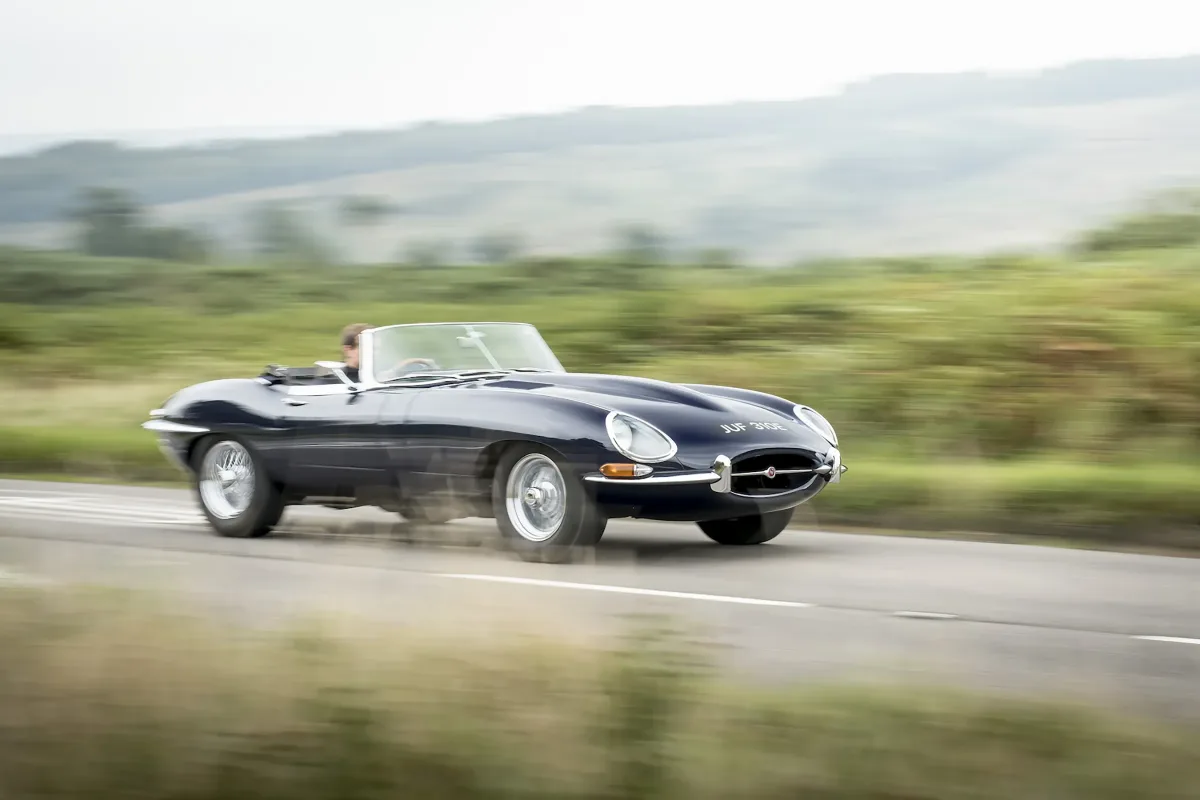
A throttle blip brings an encouraging, sharp-edged bark. Clutch down, and first gear slots home as easily as it would in a Mondeo. The lever might look the same as ever and sprout from the same place, but its action is art-stating, not archaeological.
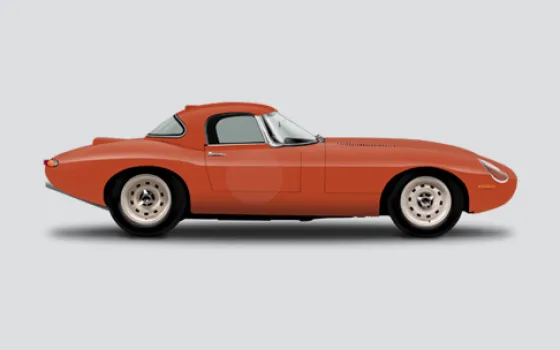
It sounds wonderful. Think racing D-type, think Rolls-Royce Merlin aero-engine, think large, thick vocal cords. It’s just the right sort of soundtrack to match the view ahead: long, power-bulging bonnet whose curves extend far beyond its own horizon.
It’s an E-type, Jim, but not as we know it. Meet the E-type for the new millennium.
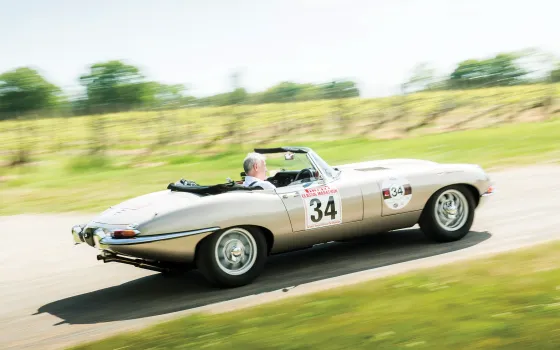
For a few moments, I’m back in 1963. The rain is sheeting down, some of it over my right arm. In front of me is the sweetest, crispest Jaguar XK engine I’ve ever experienced, a 3.8 that’s blipping keenly on the throttle, blatting this most purely beautiful of sports cars on its eager way. Shifting between the four gears takes time and timing, for this is a slow-shifting Moss gearbox with little in the way of usable synchromesh. But there was time to plan your movements back in 1963.
The E-type Series 1 accelerates up a narrow, slippery, undulating Sussex lane. It’s squirming around a little, tail wagging the dog (or, in this case, car), except when the front paws meet bumps and nudge the nose a little off course. Then I need to brake, quite hard. I see what the pundits mean, now. An early E-type’s stopping ability really is pretty marginal. The pedal’s firm enough, but it doesn’t do a lot when you need it to.
Yet, despite its shortcomings, this is a deeply lovable car. Wouldn’t it be great to fix the failings and keep the good parts, to have an E-type with its character intact but exorcised of the worry factor? Wouldn’t it just...
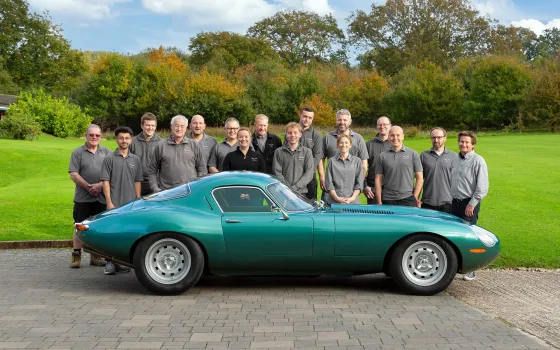
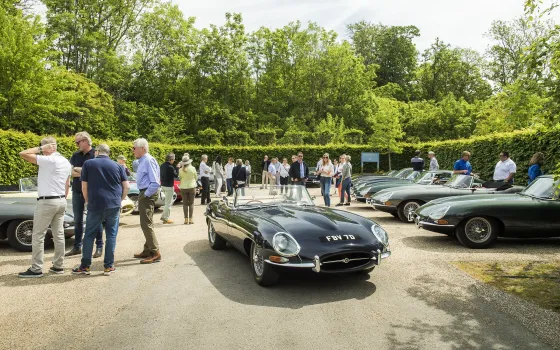
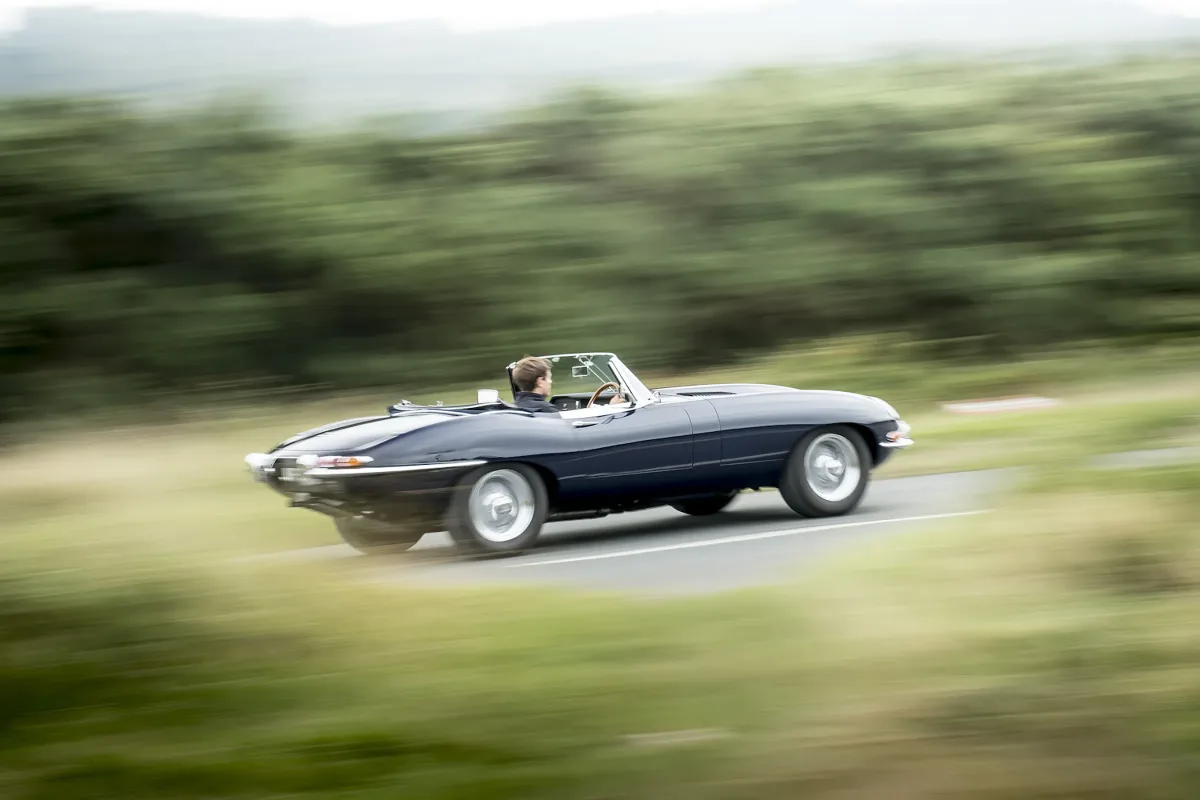
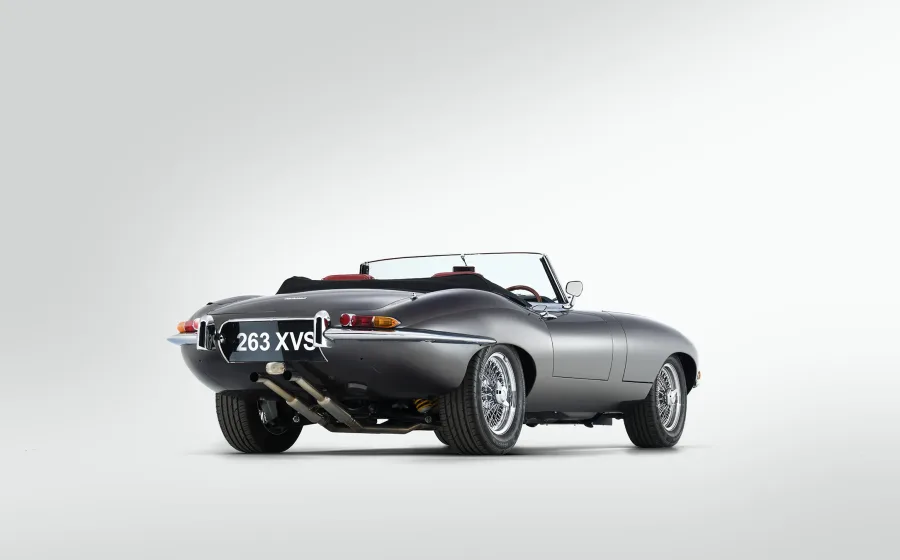
It's dark blue, very shiny, left Brown’s Lane in 1967 and has been newly remade in the car-god’s image. Except that this god isn’t sacrosanct. Henry Pearman’s Eagle E-types company will sell you a pristine original ‘E’, if that’s what you want, but time doesn’t stand still around here. If the E-type were still made today (hardly a workable idea, given crash and emissions legislation) it might, says Pearman, have developed into this.
Into what? It has brakes, big AP Racing ventilated front discs with four-pot calipers, Girling rear discs that work. The suspension has Koni Classic dampers and stiffened springs, all held in place with polyurethane suspension bushes, neoprene rear suspension mountings and rose-joints for the front anti-roll bar and the rear radius arms. The steering arms are of machined aluminium, there’s a touch of negative camber and the whole package of geometry changes is designed to banish bump-steer and keep the wheels vertical when cornering. The steering rack has a bigger pinion, too, which quickens the ratio.
Now, the powertrain, mounted on strengthened and redesigned mounts to keep it in place under the Eagle’s enhanced braking forces.
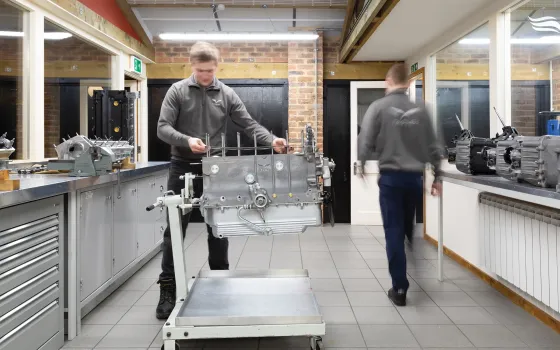
We’re talking sport-spec Eagle here, top-but-one in the performance pantheon. The Supersport (as driven for Classic Cars by Roger Bell in December 1997) is more extreme and less road-friendly, the GT and Classic specifications are respectively closer to Jaguar’s original. The 4.2-litre engine has half-race cams, a flowed head with bigger valves, and a bottom end built with the usual strengthening technology (balancing, tuftriding, lightening and so on). There’s a crankshaft damper, a lightweight geared starter, a reliable Nippondenso alternator and a mapped electronic ignition system.
Breathing in occurs via the usual sin SUs, but their mouthpiece has changed considerably. There’s still the distinctive E-type rounded-triangle air box, but the round canister beneath is now of carbonfibre and fed by a duct which starts at the front of the engine bay. It gives a measure of ram effect at speed, but not too much because SUs don’t like it. Breathing out is through a stainless-steel manifold. ‘The flange is stainless, too,’ says Pearman, ‘unlike with some people’s manifolds. They look terrible when they go rusty.’
Power? Pearman is initially coy. ‘The factory quoted 265bhp, which was a long way from the truth, so next to that our figure wouldn’t look so good.’ Oh, go on. Everyone knows that 265 was a fantasy figure, a gross measurement taken with no engine ancillaries and a wide-open exhaust. What did the original engine really make, as fitted?
‘About 190bhp,’ Pearman declares. And yours? ‘About 275 or 285bhp, plus a 40 per cent increase in torque.’ Not a bad output rise, then.
The Moss gearbox has gone, of course. Nor does the Eagle use the Jaguar-built, all-synchro replacement fitted from 1964. Instead it has Ford MT75 internals (think Escort Cosworth) in Eagle’s own casing, so it’s a five-speeder. Fifth is an overdriven ratio, but despite this our dark blue car has a starship-spec 2.88:1 differential. Its new owner is planning a lot of motorway cruising.
Torque, that's what this car is going to need, given its long legs. And that’s what a tuned XK engine needs to deliver best, because it’s no revver. The rain hasn’t abated, so my second experience of an open-top E-type (the 3.8 having just been my first) will probably have to remain closed. I’ll steam across Sussex, from Eagle’s base near Uckfield in the east over to Goodwood in the west, and hope the torque doesn’t send the tyres waterski-ing too often.
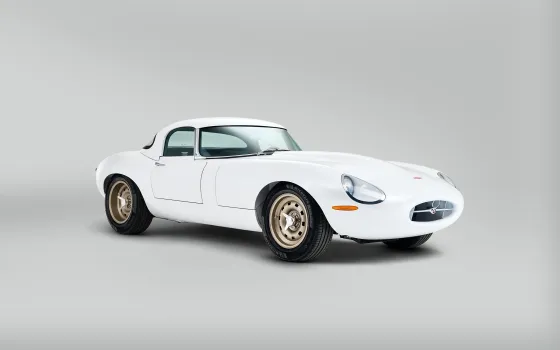
‘They’re good in the wet,’ Paul Brace, Eagle’s development guru and one of the two people who build the cars, had said earlier, ‘except on standing water.’ This is a worry, but a glance at its tread pattern makes me grateful there’s any grip at all. These are Yokohama Advan 032Rs, 225/60 R15V size on widened chrome wires, and surely those desultory diagonal grooves haven’t a hope of funnelling away so much deluge. They do look good, though, a subtle hint that this is not a standard E-type. In fact it’s the only obvious external clue; it takes a spotter to clock the halogen headlights and the subtly reshaped lower lip on the front valance. It curves down an extra two inches, to help reduce front-end lift.
Before I climb in, I take a closer look at the beautiful body.
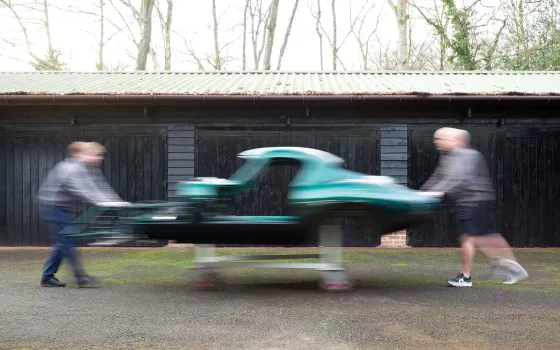
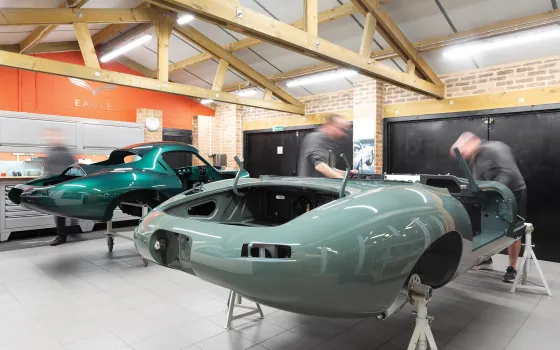
An Eagle E-type is entirely new in the metalwork apart from the bulkhead assembly, by which it retains its original identity and registration number. The panels come from Martin Robey, and are fettled into place to give a fit and a panel-gap tightness far beyond that of any original E-type. Various modifications are built in at the bare-shell stage: new holes for the extra wiring, an extra strengthening membrane in the sill assemblies, a diagonal brace at the front of the square-tube structure which bolts to the monocoque, cradles the engine and bears the front suspension. And the whole lot is properly seam-sealed and wax-injected, so this is an E-type which won’t rot (one hopes).
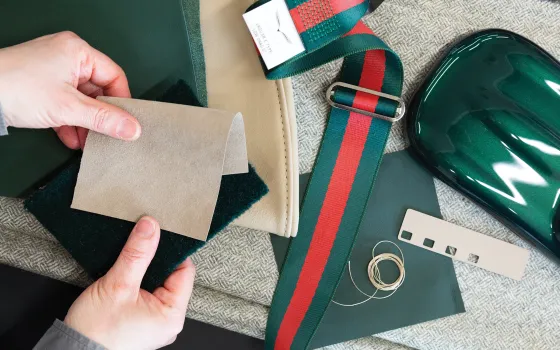
Now I thread myself into the newly trimmed cockpit, settling into an Eagle-designed seat rather stronger on bodily support than Jaguar’s version. The backrest’s upper part is tapered to allow the hood to fold without scuffing the leather; old E-types are usually a little shredded here. The wood-rim Nardi steering wheel is smaller than the original, so parking will be no picnic given the broad tyres and high-ratio rack. All else is pretty much standard, except that the hood fits properly and there’s an overcomplicated modern stereo.
Joy It still hasthe starter button. Pressed, it triggers a keen whirrup from the geared starter and kicks the deep-breathing 4.2 into life. The note is deeper, burblier, more percussive than that 3.8’s; each firing pulse means more business. The idle is steady but busily lumpy, the keen camshafts just out of their optimum operating range. A throttle blip brings an encouraging, sharp-edged bark. Clutch down, and first gear slots home as easily as it would in a Mondeo. The lever might look the same as ever and sprout from the same place, but its action is art-stating, not archaeological.
It takes maybe a hundred yards to feel the big differences. Instead of seeming to float a little way above the ground, the Eagle is wedded to it. A nudge of steering brings an instant response. Bumps and ripples don’t deflect the tail but they do excite the front wheels. It’s bump-steer of a different sort, as we shall see.
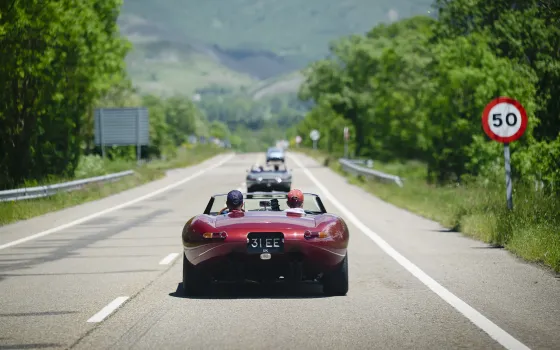
Taut, but not highly strung. That’s the feel so far. I’m out on the A272, a road largely untouched by millennial meddling and excess street furniture, much the same today as it would have been when the E-type breed was young. Apart from the traffic volume, of course; torque, and the overtaking it empowers, will be my friend today.
It arrives in shovelfuls almost from idling speed. This car’s gearing may be intergalactic but it doesn’t stem the head of steam. Squeeze the aluminium accelerator pedal and the E-type leaps into action, with a particularly rich seam of thrust between 1000 and 3600rpm. That doesn’t sound very racy, does it? Naturally the thrust continues to flow beyond those speeds, but there’s little point in going beyond 5000rpm. The engine isn’t smooth up there, and even at 4000rpm it has already lost the sweetness of that old 3.8.
So, until you’re out on big, wide roads and moving really quickly, you let the engine move in that torquey, effortless, deep-breathing sweet spot. With 70mph representing just over 2000rpm in fifth, and – incredibly – vigorous acceleration on offer from 1000rpm even in this gear, revving just isn’t on the agenda. ‘It’s all about torque,’ said Henry Pearman as he deflected questions of power. He’s right. Think of the best modern turbodiesels, and add the crispness of three SUs and no turbo lag. That’s the sort of power delivery we have here. No stumbling and no pinking, either. Mapped ignition – Eagle sets its cars up with a laptop on a real road route – is mainly why.
Unlike a turbodiesel, though, it sounds wonderful. Think racing D-type, think Rolls-Royce Merlin aero-engine, think large, thick vocal chords. It’s just the right sort of soundtrack to match the view ahead: long, power-bulging bonnet whose curves extend far beyond its own horizon, and three frantically flicking wipers clearing the semi-wraparound windscreen with as much energy and efficiency as they can muster.
HERE’S A roundabout. Do I dare pile into the curve, plant my accelerator foot floorwards as the E-type settles, live life on a slithering, oversteering edge? Not just yet. Let’s learn to trust it first. Paul Brace again: ‘E-types are so vague on normal tyres,’ he says, ‘that you can’t feel the discrepancies in the geometry. Once you’ve got decent tyres and spring rates, and the tyres are biting, you can. Then you know what to change.’
The most important thing is to match the dampers to the spring rates. We just use the normal rules when setting a car up, plus a lot of experience. With this car, you can go into a bend hard, snap off the throttle and it will just sit and stay there. The standard car goes all over the place if you do that. Then you can stamp on the throttle, make it oversteer and keep the tail out if you like. If you don’t like it, we can change the balance.’
I do like it. This is a car balanced as naturally as a car can be, the gateway to its discovery a front end of astonishing bite. It’s the single biggest dynamic difference between this Eagle E-type and the way Jaguar did it with the knowledge of the time. The steering may be a little too eager for some tastes, especially as the Eagle just loves to climb white lines, follow ruts and pursue cambers, but it’s not ‘old-E bump-steer’. It’s those tyres. Eagle’s footwear alternative is Pirelli P6000, softer and rounder-shouldered. You choose.
That’s part of the point. Eagle builds an E-type to suit your tastes and desires, but makes a point of finding out what these are. The Eagle catalogue is dripping with go-faster temptation, but not all of it might suit your needs. ‘If someone ticks all the boxes,’ says Paul Brace, ‘we wouldn’t say “Yes, yes” – we’d try to find out what they really want.’
If this car were mine, I’d want slightly softer damping to banish the fidget, a lower-set driver’s seat and an accelerator moved back so it’s on more of a level with the brake. Then I’d more easily be able to flick my right foot to the middle pedal, and use the stopping power that’s as eyeball-extending as the original E-type’s was heart-stopping. No wonder Eagle has had to beef-up the engine mounts.
At first I thought I might like the steering wheel a little further away, too – it adjusts telescopically from near to very near – but the steering weights up so much in fast corners that you can do with the leverage. Partly that’s down to the revised suspension geometry, partly to the quicker rack, partly to the huge grip the Eagle can generate. It’s surprising how quickly you can learn to trust this grip, even in the wet, because the E-type’s reactions are so faithful and intuitive. Another thing. There’s no structural wobble at all.
I got to Goodwood, and it was still raining. My destination was not the motor circuit, though, but a friend’s house nearby. It was her birthday; we went for a squirt through the South Downs, she was captivated by the Eagle’s gorgeousness. It certainly worked for her.
Did it work for me? On a faster return route which contained plenty of A27 dual carriageway, as darkness fell and halogen lights lit my path, as the rain splashed relentlessly, the sense the Eagle makes became more complete. The confidence it generates is 2001, but plenty of the 1961 vibe remains.
Mission definitely accomplished, then.
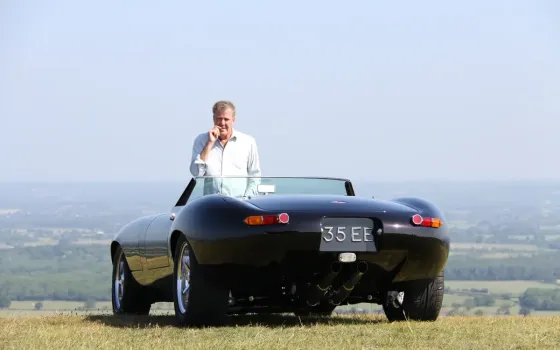
Clarkson quite likes the Eagle. And he’s proved it by voting the Eagle E-type into the number one slot in his latest video, Clarkson’s Top 100, and proclaiming it Car of the Century.
Jeremy Clarkson’s respect grew during 20,000 miles’ driving in a dark blue 4.2 for the video’s filming. That car, a 1967 example, was supplied in haste by Henry Pearman in standard form apart from, as Jeremy says, ‘big brakes and big cooling’.
‘We had a blow-out in Germany, in the town where Pirelli had a factory,’ recalls Britain’s best-known car critic, ‘so that was OK. It also lost its oil and water in France for no obvious reason, but we got it to a garage which just happened to belong to the local Jaguar club chairman. It was fine afterwards.’
‘Modern cars are too heavy and complicated, so what Eagle are doing is a great idea. It’s all very well having a car that’ll do 150, but if you need all Belgium to stop it.